Complete guide: How to water your cannabis plants

Improper watering can ruin your crop, even with the best genetics
You can have the best genetics on the market and a premium substrate, but if you fail at watering, everything falls apart. In cannabis, watering isn't just pouring water : it's about mastering the frequency, volume, quality, and the exact moment the plant needs it.
Doing it right is what separates a technical grower from one who improvises.
How often should you water cannabis indoors?
There is no universal rule, but there is a key concept: dryback , that is, the percentage of drying of the substrate between one watering and the next.
- In soil , dryback is slow, uneven, and difficult to control. Overwatering is a real problem here: the substrate can remain saturated for days, suffocating the roots and promoting fungal growth. The rule of thumb is to water again when the pot has lost 30–50% of its saturated weight . Simply put: when the top 2–3 cm are dry and you notice the pot weighs significantly less when you lift it, it's time to water.
- In coco coir , dryback is fast and uniform. Even when soaked, coco coir retains oxygen, allowing for more frequent and aggressive drying. The ideal range is 20-40% moisture loss before watering again, depending on whether the plant is in the vegetative or generative stage . This allows for multiple hydration and oxygenation cycles in a single day, especially during late flowering.
Watering frequency: soil vs coco
Here's the real difference between the two substrates: the watering frequency .

In summary: in soil the frequency is limited by the substrate structure, in coco it is the most powerful tool to direct the cultivation.
Dryback on soil vs. on coconut: key differences

Hydroponics and coconut: absolute precision
In hydroponics, irrigation becomes constant fertigation . The roots are in direct contact with the nutrient solution, which necessitates daily pH monitoring (5.5–6.0).
In coco coir, which should be treated as what it is—a hydroponic medium—the logic is the same: each watering cycle must provide fresh nutrients and oxygen . Here, dryback and watering frequency are the most direct ways to influence the plant's physiology.
Cuttings and seedlings: how to water at the beginning
In cuttings and seedlings, the priority is not the amount of water, but maintaining a humid and oxygenated environment.
- Ambient humidity: 70–80% with propagator.
- Spray leaves with water at pH 5.8–6.0.
- Water the substrate just enough to keep it active, without waterlogging it.
Important note: In completely inert substrates such as rockwool , it is necessary to pre-fertilize with a light solution (EC 0.4–0.6) before inserting the cutting. Watering with only water destabilizes the medium and inhibits root development.
The pH of water: the great forgotten factor
An out-of-range pH blocks nutrients even if you use the best fertilizers.
- Earth: 6.0–6.5
- Coconut and hydroponics: 5.5–6.0
Measuring and adjusting the pH before each watering is not optional.
The best time to water
Always at the beginning of the light cycle. The plant makes better use of water and nutrients during the day, and you reduce the risk of fungal growth by avoiding excessive humidity at night.
Never water right before turning off the lights.
Manual or automatic: how to choose
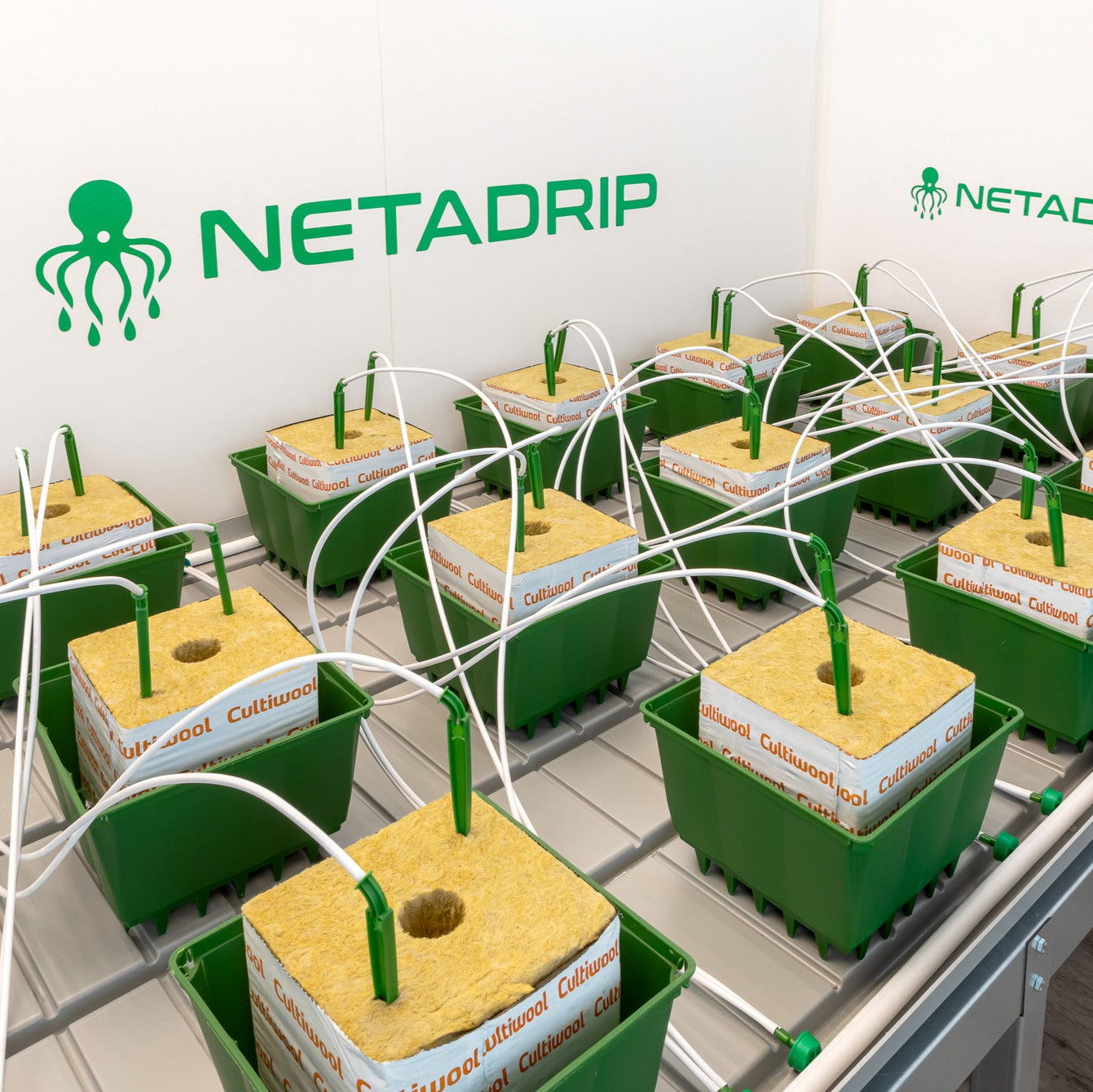
Hand watering works and has been producing results for years, but just as we switched from sodium to LED lighting, more and more growers are making the switch to automatic irrigation. As you scale up, an automatic system is the only way to maintain precision and consistency.
- Ensure proper drainage.
- Avoid forgetfulness and excesses.
- Improves homogeneity and overall performance.
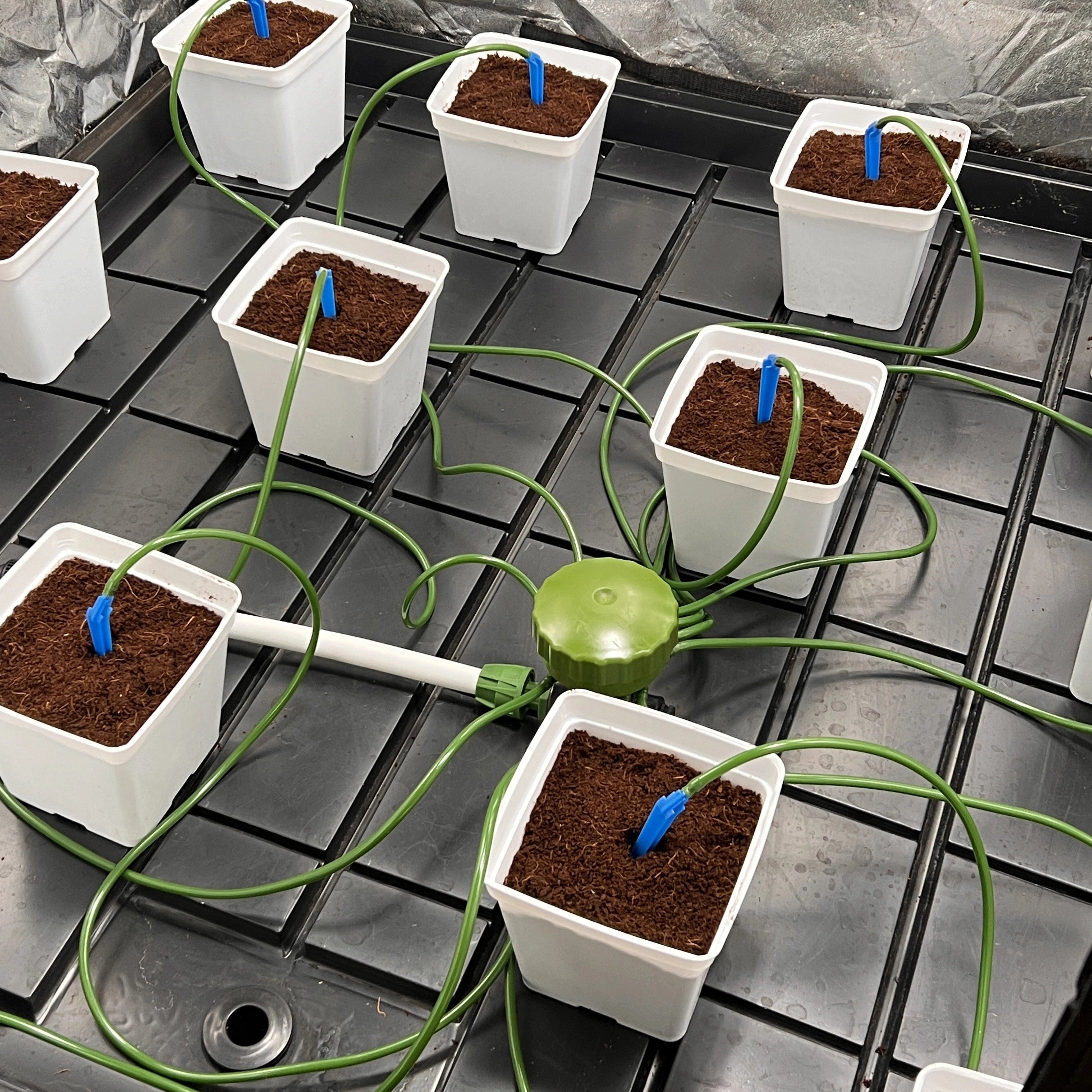
At Netadrip we designed two specific solutions:
 .
.
Conclusion
Irrigation is the most powerful tool for managing a crop. In soil, the key is to avoid overwatering, respect the 30–50% dryback, and not be afraid of drainage, as it also helps maintain the NER (Nutrient Residue). In coco coir, drying is your ally: 30–40% moisture loss and several daily waterings with drainage are the strategy that takes the plant to its maximum potential.
This is just the introduction. If you want a complete masterclass on coco coir irrigation , with advanced strategies for frequency, EC, and drainage, we've prepared a free ebook that's the most comprehensive guide on the subject in Spanish.
👉 Download it here: "The guide to growing in coco coir"


Written by Ricardo Mosquera Lopez